More thoughts on Open Access Journals

Recently an article in Science surveyed open access journals and found a number of distressing findings with respect to the peer review process.  An overview is available at: http://www.scidev.net/global/publishing/news/sting-exposes-wild-west-of-open-access-publishing.html?utm_content=bufferb2a6d&utm_source=buffer&utm_medium=twitter&utm_campaign=Buffer

The original version in Science is at: http://www.sciencemag.org/content/342/6154/60.full

As the Science article acknowledges, the same results could be found if we did a survey of traditional journals as well.  However, this was not done.  It would be interesting to see the results if PLOS One or another leading open access journal surveyed the traditional journal field.  Clearly, open access has opened the gates of “for profit” publishing wider, but I know of no serious academic that would either publish in such disreputable journals or seriously consider their work as quality research.  However, the Science article buries the problem with academic publishing beneath the castigating byline on the perils of open access journals.  While the pay for publication practices of some OA journals are clearly problematic, so is the traditional model of publishing, which is clearly broken.  Resting on the free labor of academics, publishing houses are currently reaping substantial profits.  These outfits are often slow (cutting research appearing years after the fact), exclusive (charges of $50+ for a typical article), and Western country-biased.  None of these four issues is mentioned in the original article, and none of these is necessary any more.  They can and are being addressed – mostly through Open Access publications.

Personally, I am closely involved with a few open access journals (and a few traditional journals as well), and they do a great job at ameliorating these problems without the shortcomings noted in the article.  The International Journal of the Commons is double-blind peer-reviewed by 3 reviewers (at minimum), has an editorial board of highly reputable and energetic scholars, and is supported by both the ISI Web of Science and Scopus, the two leading academic journal indexing bodies.  It is also free to download our articles, with most articles attracting hundreds or thousands of downloads.  It makes articles immediately available on our website without the wait for quarterly or semi-annual issues.  In addition, many of our readers, contributing authors, and reviewers are from developing countries with limited access to the traditional published journals.  IJC eliminates the problems of so many traditional publications without sacrificing high quality or reviewing standards.  My experience with Ecology and Society is the same on all counts.

Before jumping to conclusions and throwing all OA journals into the fire, let’s run the same test on traditional journals.  Then we can go back and focus on what’s important – high quality scholarship.  From there, we can look to the other problems that I’ve mentioned – speed, cost, and access.

More on Institutional Developments from the Great Barrier Reef

A month ago I wrote about research findings on institutional analysis in the Great Barrier Reef Marine Park.  At the time I noted two interesting developments – one on the efficacy of polycentricity and conflictual findings from the GBR Marine Park.  Basically, the park has a monocentric structure but efficiently uses zoning to achieve some desirable outcomes.  The second interesting research finding is about property rights.  I’ll try to keep this short and to the point for non-academic readers so your eyes don’t glass over immediately.

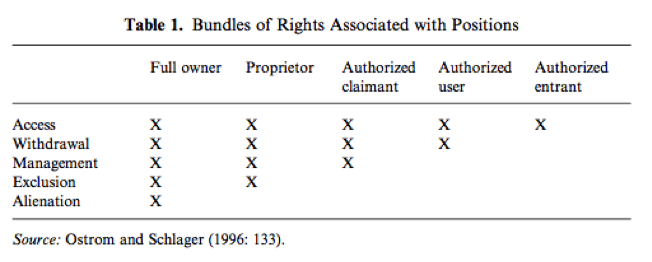
In essence, most institutional analysts are familiar with the Schlager and Ostrom work on property rights (Schlager, Edella, and Elinor Ostrom. “Property-rights regimes and natural resources: a conceptual analysis.” Land economics (1992): 249-262.).  In this piece, they lay out a conceptual map for bundling of various types of property rights with a goal of showing that ownership is more than a simple binary division.  Their revised table (from a 1996 book chapter) looks like this:

Bundles

As one moves from the position of entrant to user and eventually to full owner, we see the associated bundles of property rights increasing.  This greatly clarified the issue of property rights as complex bundles of goods.  It expanded our thinking from that of a binary (ownership or not) to a deeper understanding that the concept of ownership comes with nuance.

However, in our current work, we see examples in which such a step-wise progression still oversimplifies the process.  Through the use of fishing rights (individual transferable quotas or ITQs), for instance, we see owners with the rights of access, withdrawal, and alienation (selling of rights) without the rights of management or exclusion.  Likewise we see others – managers – with management and access rights without the rights of withdrawal or alienation.

It’s time to start reexamining the bundles of property rights and look at the innovative ways in which bundles can be packaged and the ramifications of various packages.  This has implications for both scholarship and for practice as we think about new ways to govern.  As expected, the complexity continues to grow.  Very interesting topic for future research.

Systems Thinking Class Activity and Leverage Points

This morning we ran a bit of an experiment in my Systems Thinking class (mostly sophomore level undergrads).  This comes from the Meadows “Systems Playbook” text.  We formed two groups for ease of organizing.  One group of 8 was run by my TA.  I ran another group of 26.  We gave everyone a number and then had them select two other students as the “reference points”.  However, we gave them some stipulations.  First, if their own number was an odd number, they had to select Student Two.  Second, no one was allowed to select any of the three students wearing red shirts (my randomizing process for my group of 26).

We then asked them to move around until they were equidistant from their two reference points.  Before moving we discussed as a group what they thought would happen.  (Perhaps ask yourself the same question before reading ahead).  When they started moving, it took a couple minutes of shuffling around, bumping into each other, getting a tad too close, etc before settling into a stable formation.

Next, we had everyone return to the circle.  We then ran the same experiment except that when I said “stop”  the three Red Shirts  stopped moving while everyone else continued.   When the others settled into a formation, I said “go” and the Red Shirts moved again.  At this point there was a minor amount of shuffling around, but because none of these three could serve as reference points for others, they made very little difference on the rest of the group.

We returned to our original circle and ran this game a third time.  This time I randomly selected 3 people plus Participant 2 (the reference for the odd numbered participants).  When I said “stop”, these four stopped.  Once the formation emerged, I then said “go” to the four that I had stop earlier.  Because of Participant Two’s high leverage, the system had to reorganize substantially before coming to a halt again.

Finally, we ran the first treatment again with one exception.  This time we added a three second delay between when their reference moved and when they responded.  This caused quite a commotion and the delay kept the system from “equilibrating” in a reasonable amount of time.

This little adventure took about 20 minutes.  At that point, we went back to the classroom and discussed leverage points in systems and related it back to that day’s reading and how these concepts manifest themselves in the experiment.

I highly recommend it.

Video of Water/Climate Briefing

Last week, along with Jonathan Koppell, the dean of ASU’s College of Public Programs and Doug Toy, the city of Chandler’s Water Regulatory Affairs Manager, I participated as a panelist for the first of this year’s Water/Climate Briefings for ASU’s Decision Center for a Desert City.  The discussion was on “The Challenges of Communicating Sustainability in Complex Systems for Public Policy”.  For those interested, here is a link to the video: http://dcdc.asu.edu/outreach/waterclimate-briefings/

Enjoy!

Institutional Analysis in the Great Barrier Reef – Part I

Recently I have had the good fortune of working with some amazing colleagues and marine ecosystem experts – Natalie Ban, Louisa Evans, and Mateja Nenadovic – on the Great Barrier Reef and the GBR Marine Park.  As an institutions scholar, two particularly interesting aspects emerged in studying the marine park – one regarding the nature of property rights and another on the benefits of polycentricity.  Here I focus on the polycentric elements – hopefully to be in print early next year.  I’ll write more on the second interesting finding, on property rights, in a subsequent post.

Polycentricity is a governance system in which there are multiple interacting governing bodies with autonomy to make and enforce rules within a specific policy arena and geography. These multiple governance groups interact horizontally with other groups at the same level as well as across scale as a part of nested systems of governance.  Often polycentricity has been seen as enhancing the resilience of a governance system because, among other things, it 

  • creates a foundation for learning and experimentation,
  • provides a source of policy/institutional diversity,
  • enables broader levels of participation, and
  • improves connectivity between groups while building in modularity and redundancy. 

Polycentricity, in effect, provides a means to solve problems at the scale of the problem – not too big to be removed from it and not too small to be overwhelmed.

And then we started looking at the GBR Marine Park.  In this case, we have an enormous system (133,360 sq miles or 345,400 km²) governed by a single governing body and act of legislation.  And it is generally seen as being quite successful.  So what gives?  Are the concepts of polycentricity misguided?  Is the case an anomaly?  

Stay tuned for the paper…but I’ll leave you with part of the answer – zoning.Image

National Park Twins

In my free time for extra writing, I’ve been dwelling on the idea of a travel book that focuses on what I call National Park Twins.  The idea is to look for places that may be a bit off the beaten path, that share the beauty and grandeur of many of the national parks without the crowds.  Anyone that has been stuck in a “bear jam” in Yellowstone or Glacier understands what I’m talking about.  In many cases there are great options with similar scenery in nearby public lands – land that is national forest, BLM managed, in state trust, but readily available for hiking, camping, climbing, hunting, and so on.  These places may lack interpretive signage and have only primitive services, but they have spectacular sights, open space and few people.

Some examples:

The Everglades and Big Cypress (photo from National Geographic)

Big Cypress

The Grand Canyon/Arches/Bryce/Zion and The Wave/Antelope Canyon/Grand Gulch (photo from National Geographic)

The Wave

Glacier National Park and the Bob Marshall Wilderness (photo from Backpacker Magazine)

Bob Marshall

In each case, these are photos from the National Park Twin.  While it’s not possible to see Old Faithful, Going-to-the-Sun Road or Bridal Veil Falls at the Twins, you are often surrounded by wilderness and solitude rather than RVs and hundreds of people.

Give it a shot.  Get off the asphalt and hit the dirt.

Open Access International Journal of the Commons now indexed!

Some time ago, I wrote a post (https://michaelschoon.com/2011/06/21/international-journal-of-the-commons-now-on-scopus/) about how IJC was finally being recognized by Scopus, the primary academic indexing organization in Europe.  I am happy to say that after two more years of sweat equity, the International Journal of the Commons (http://www.thecommonsjournal.org) is now recognized by ISI, the leading publishing group in the US.

The importance of this stems from being an open access journal.  It seems that Open Access publishing is a real touchstone in academia now with a slew of articles in the Chronicle, on academic blogs, and through the big-time publishing houses.  Many of the charges against open access publishing are ridiculous, but a number of unscrupulous, for-profit open-access journals create an atmosphere where publication seems based solely on ability to pay.  This is decidedly not what open access publishing is about.

IJC publications are paid by the contributing authors after rigorous peer review (with exceptions made for developing country authorship).  This is where ISI recognition helps.  It shows that our journal abides by stringent standards, publishes high quality literature, and contributes to the scientific advancement of society.  At the same time, authors retain their copyrights, articles are accessible anywhere there is an internet connection for free, and our readership can move to practitioner and developing country readers beyond the paywalls of the main publishing companies.  ISI examined our 7 years of publication, the quality of our authors, the citation rates for the articles, and the consistency of publication.

Congratulations to my co-editor and friend, Frank van Laerhoven, to Erling Berge for his editorial prowess over the past several years,  to our outstanding editorial board, to the institutional support of IASC, and, most importantly, to our diligent and dedicated reviewers.  Without all of your help, this achievement would not be possible.  Thank you!

A Different Classroom Experience

I’m trying a new pedagogical approach to the sophomore-level undergraduate course that I’m teaching this fall.  The course is called “Systems Thinking”.  I’m trying to avoid creating a boring, lecture-driven class for one of the undergraduate required core in ASU’s School of Sustainability.  Inspired by some of the recent work in Problem- and Project-based Learning (PPBL), I’ve come up with the following alternative.  Because this is a lower-level undergrad course with a number of topics that I want to make sure we cover, I didn’t think that we (I?) could handle a class that had a very strong outward, societally-driven, real-world project at its core.  Instead, I’m trying to build a forum for discussing ideas.  I’ve implemented parts of this in class before.  Just never to this extent.

The typical class session is structured like this:

Announcements, Framing the class session – 5 minutes

Discussion Leads – 10 minutes

Think-Pair-Share – 15 minutes (2 minutes thinking independently, 5 minutes with partners, 7 minutes with a few of the groups sharing with the entire class)

Lecture – 10 minutes

Rapporteurs – 5 minutes

Concluding comments – 5 minutes


Let me expand on the discussion lead role and that of the rapporteur.

Discussion Leads

Most classes will have 2 discussion leaders.  Discussion leads will have three roles or tasks.

The first task will be to meet with me in the days before your class session, typically at least 2 days beforehand. These meetings will be short, but they will help organize thoughts on the readings.

The second part will require carefully reviewing the readings for the class session.  Leads will then write a 1-page memo on the readings, guided by our meeting and the key questions that I have identified for the class period.  The memo should accomplish several things.  First, it should provide initial answers to the questions.  Second, it should raise any questions or areas that were unclear.  Third, it should provide “access” points for a facilitated discussion in class.  Feel free to discuss any differences or disagreements that you have with the author, weak arguments, etc.  The memos will be due the day before the class that they discuss.

The third part will take place in class.  The Discussion Leads for a given class will lead the class discussion.  This should introduce the topic, provide initial answers to the key questions that I raised for the day’s readings, and bring forward any other issues.  This will cover roughly 10 minutes. This will lead directly into the “think-pair-share” period.

The Rapporteur

Rapporteurs’ tasks are to take notes at meetings of importance, such as this class.  In parallel to the Discussion Leads, the Rapporteurs will keep track of discussion in class.  In particular, they will note areas of confusion, questions that need further exploration, and important points that were raised.  After the lecture, the rapporteurs will provide a synopsis or wrap-up of the class.

Beyond the class structure, I plan to have guest speakers for a few classes to bring in real-world examples.  I also have a field trip to ASU’s Decision Theater planned (http://dt.asu.edu/).

If anyone has thoughts, comments, or suggestions, please feel free to share them.


Worldviews and the Edge of Science

I happened to glance at an Economics forum where advocates from two different sides of a policy debate continued to launch “scientific” salvos at the opponents.  The debate was about the Fed and real versus nominal interest rates effects on the market, but nevermind.  It could have been International Relations scholars debating Realist vs. Liberal policies, policy wonks from the Cato Institute arguing against policy wonks from the ACLU, and so on ad nauseum.  In my mind, this specific debate sparked a couple intertwined thoughts.

The first goes back to my academic mentor, Elinor Ostrom.  I always found it interesting, humorous, and bizarre to see various groups take her work and twist it to support their (policy) agendas.  Whether it was some of her public choice work being seized upon by right-wingers, her small-scale, development work in developing countries by left-wing idealogues, or some other mix, it amazed me to see her work cited and utilized across the political spectrum.  Each group seemed to think that she was in their camp.  This seems quite unusual with many scientists, particularly social scientists, identifying and identified with certain ideological groups.  Think about the role of several other Nobel Laureates – Milton Friedman on the one hand (right hand, as it were), Paul Krugman or Joe Stiglitz on the other (left) hand.  This lead me back to a long-running discussion with a colleague of mine as to whether these scientists would/could ever come to the same conclusions scientifically.  My colleague insists that “science is science” and the data will provide the answer.  I take the position that this may hold for a small treatment conducted in isolation, but my gut tells me that the science generally supports the scientists’ worldview more generally.

Clearly this varies across the disciplinary spectrum, but it seems likely that once we leave the natural sciences this problem becomes pervasive – compare astrophysics (perhaps less of a problem?) with sociology or political science, for instance.  To further complicate matters, scientists are increasingly taking normative positions up front.  The Society for Conservation Biology, for instance, has a mission to “advance the science and practice of conserving the Earth’s biological diversity”.  Many climate scientists have similar belief systems regarding earth system science.  ASU’s School of Sustainability mission is likewise normative calling to “develop practical solutions to some of the most pressing environmental, economic, and social challenges of sustainability.”  Similarly, the Planetary Boundaries literature takes scientific research and seeks to “mobilize thousands of scientists while strengthening partnerships with policy-makers and other stakeholders to provide sustainability options and solutions in the wake of Rio+20 [emphasis added]”.

With these, and countless other examples, how do we reconcile our science and our worldviews?

Improving Transboundary Protected Areas Information

I’m currently in the midst of improving the state of knowledge on transboundary conservation and transboundary protected areas (TBPAs) in particular through two research projects.  The first of these, as a part of the Social-Ecological Systems Meta-Analysis Database (SESMAD) project, is coding a number of cases of both TBPAs and Marine Protected Areas and trying to ascertain the state of knowledge across large-scale conservation areas.  This will enable us to draw comparisons across marine and terrestrial parks, to see if the same success factors matter in both and what kind of outcomes can be expected.  This may enable future event-history analyses to see what conditions enable the emergence of protected areas as well.

Photos of Waterton-Glacier International Peace Park

images waterton

Glacier image

Photos of Great Barrier Reef Marine Park:

GBR photo

The second project is a review of the Best Practices for Transboundary Conservation guidelines that IUCN, the World Conservation Union, originally published in 2001 (Sandwith, Trevor, Clare Shine, Lawrence Hamilton, and David Sheppard. “Transboundary Protected Areas for Peace and Co-operation.” Best Practice Protected Area Guidelines Series 7 (2001): 111.).  The goal is to publish a revised version based on the scientific insights over the last 12 years.

Sandwith